
There is a character in Turkish literature called Ali Rıza Bey, the father in Reşat Nuri Güntekin’s novel Yaprak Dökümü (The Falling Leaves). He is not a bad man. He is the most well-meaning person in the house. But every time something difficult comes up he steps back so the peace is not disturbed, says “this is not the moment”, and leaves it to next time. By the end of the book the family has fallen apart and you cannot point to a single large mistake. There are only a hundred deferred small decisions.
This post is about what that same reflex costs inside a company. I had an eight-year hosting price increase sitting in front of me. I did the arithmetic the other day and, honestly, I was surprised too.
How it started
It was 2019. A family friend had been through a bad experience and asked us for a small favour. We looked, and the picture was scattered. Domains and hosting spread across three separate companies, and nobody could say who had access to what.
The first thing we did was not technical at all. We took ownership of the accounts. The companies stayed the same, only control changed hands. That was the one urgent thing, and it got done.
I should also mention that every year he turns up with a new domain idea, and that idea starts moving towards reality about four or five years later 🙂 So the portfolio never shrank, it only grew.
Then the real priorities arrived, and they were legitimate ones. A brand that is known in its global market, but the internal ERP had to be replaced and the dealers in Italy, Dubai and Poland had to integrate with the new system in Turkey. Four countries, four different ways of working. We treated each country as its own year and brought them all together on a shared ERP. It was completed this year.
And for those four years, domains and hosting were always “the next plan”.
The same conversation at every renewal
The portfolio is not small: more than 100 domains and 15 separate hosting accounts.
We tidied the domain side over time. It used to be spread across six or seven companies; we brought it down to two providers so everything could be managed from one place. We could not get to a single provider because extensions like .eu and .co.uk have their own rules. Our preference was always GoDaddy.
We did not touch the hosting side. Meanwhile something else happened quietly: both of the companies in question were absorbed into team.blue between 2020 and 2022. We did not dwell on it at the time. It was not even on our radar.
At every renewal period we went back to him. With far more effort than the work paid us, because each account needs its own tracking. And every time we said the same thing: instead of paying for these one by one, let us move to a reseller plan, put everything in one panel, and cut the cost significantly.
We are a company that watches costs, so we kept pushing. But we could convince neither the management nor the agency they worked with. The answer was always the same:
“Let’s not break a system that works.”
That sentence is hard to argue with. Nobody wants to break anything. But the truth is it is not a decision, it is the postponement of one. And the invoice for postponing arrives every single year.
So I sat down and worked out that invoice.
Looking at the invoice: eight years of hosting price increases
Here is the payment history of one shared hosting plan. The account has been with the same provider since 2017; we took it over in 2019. Eight years, same plan, same quota, same service. No upgrade of any kind.
First the raw version, from the provider’s own panel:
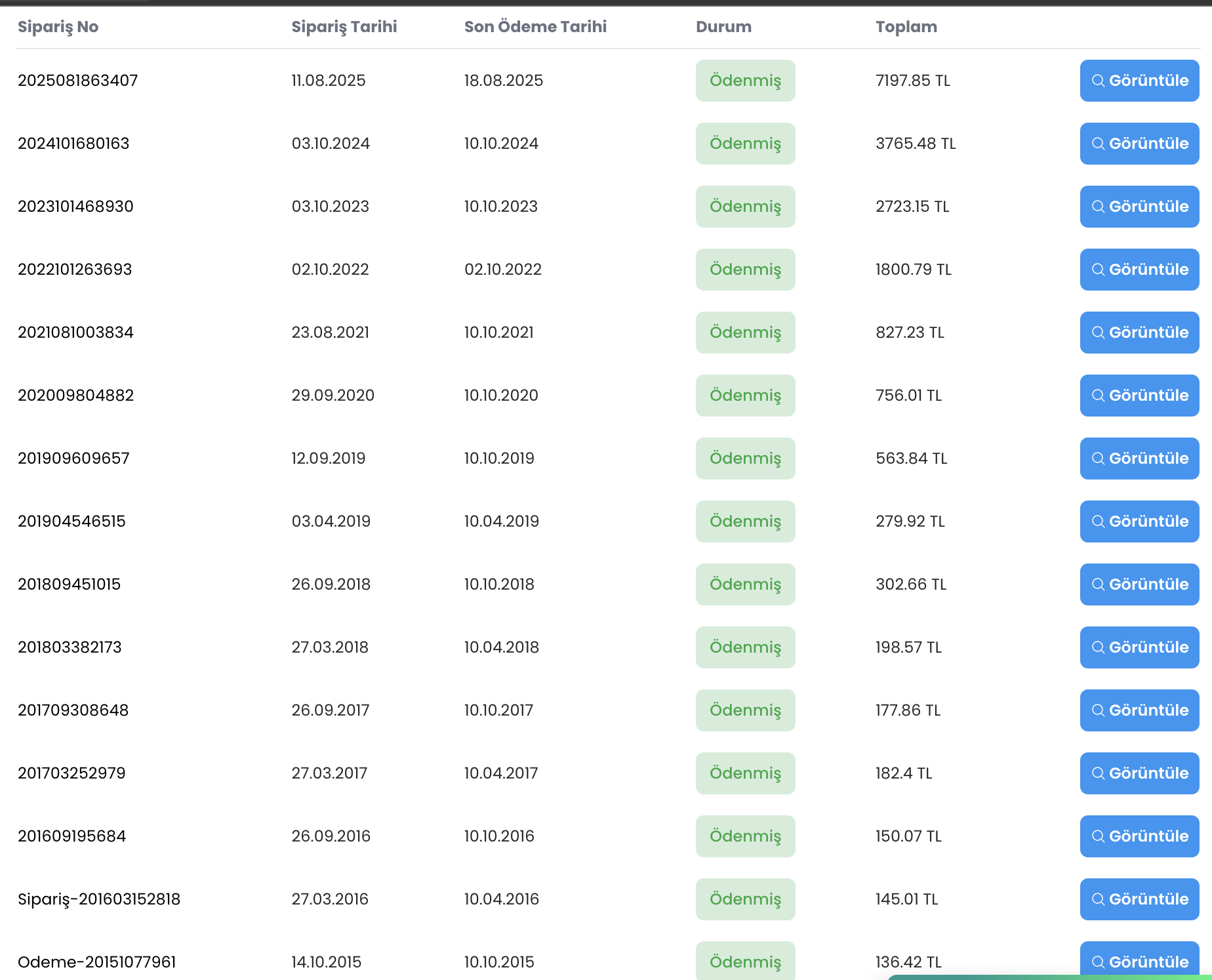
Now the same numbers next to the exchange rate of the day:
| Year | Paid | Approx. USD/TRY | In dollars |
|---|---|---|---|
| 2017 | 360 TL | 3.65 | $98.70 |
| 2018 | 501 TL | 6.30 | $79.56 |
| 2019 | 844 TL | 5.75 | $146.74 |
| 2020 | 756 TL | 7.75 | $97.55 |
| 2021 | 827 TL | 8.45 | $97.90 |
| 2022 | 1,801 TL | 18.60 | $96.82 |
| 2023 | 2,723 TL | 28.00 | $97.26 |
| 2024 | 3,765 TL | 34.20 | $110.10 |
| 2025 | 7,198 TL | 40.90 | $175.99 |
Looking at the left column, the first thing anyone thinks is “well, Turkey has inflation”. I thought that too and was about to close the file. Then I got curious and converted every payment at the rate of the day.
Ninety-seven dollars, four years running
2020, 2021, 2022, 2023. Four consecutive years, the dollar cost of the service lands around ninety-seven dollars.
That cannot be a coincidence. The plan was priced in dollars, and the entire rise on the TL invoice was coming from the exchange rate.
Credit where it is due: every TL increase between 2020 and 2023 was justified. For a hosting provider operating in Turkey with a cost base largely tied to foreign currency, that is exactly the expected behaviour. Nothing to argue about.
Then the anchor broke.
$110.10 in 2024, $175.99 in 2025. A price that had not moved in dollar terms for four years rose 81% in dollar terms within two.
One thing caught my attention here. I cannot speak to the provider’s intent, but the timing is interesting. As I mentioned above, both companies had been absorbed into team.blue between 2020 and 2022. The price did not move in dollar terms until 2023, then rose 81% over the next two years. That is the familiar shape of extracting more revenue from an existing customer base after an acquisition.
“But the lira is being held up”
I made this objection to myself, because it is a fair one. The lira appreciated in real terms over the last two years. Measuring in dollars ignores the provider’s rising costs in TL: staff, rent, electricity.
So I ran a second measurement, this time against TurkStat’s consumer price index.
| Period | Price | CPI | USD/TRY | Real, in USD | Real, vs CPI |
|---|---|---|---|---|---|
| 2020 > 2023 | 3.60x | 3.51x | 3.61x | 0% | +3% |
| 2023 > 2025 | 2.64x | 1.88x | 1.46x | +81% | +41% |
| 2017 > 2025 | 19.98x | 10.38x | 11.21x | +78% | +92% |
Two things come out of this.
First, the part that vindicates the provider holds under both measures. Real increase between 2020 and 2023 is zero. So that finding was not an artefact of the dollar anchor; inflation says the same thing.
Second, the anomaly narrows but does not close. 41% instead of 81%. The true figure sits somewhere between, because a hosting company’s costs are neither purely TL nor purely dollar. Hardware, NVMe drives, transit bandwidth, cPanel and CloudLinux licences are paid in foreign currency; the data centre, electricity and staff in lira. Split it evenly and the real increase is roughly 60%.
Whichever measure you pick, the answer points the same way. Only its size is up for debate.
There is also the mirror objection: someone will say the official inflation figure is not trustworthy. If real inflation is higher, the provider’s TL costs rose more and its defence gets stronger. But a consumer price index is not a hosting company’s cost basket. It is weighted towards food, rent and transport, which is a poor proxy for server hardware and software licences. In this sector, measuring in dollars is not an arbitrary choice, it is the right one.
The second account leaves nothing to argue about
There is a second account with the same provider. We opened this one on a promotional price. Its invoice looks like this:
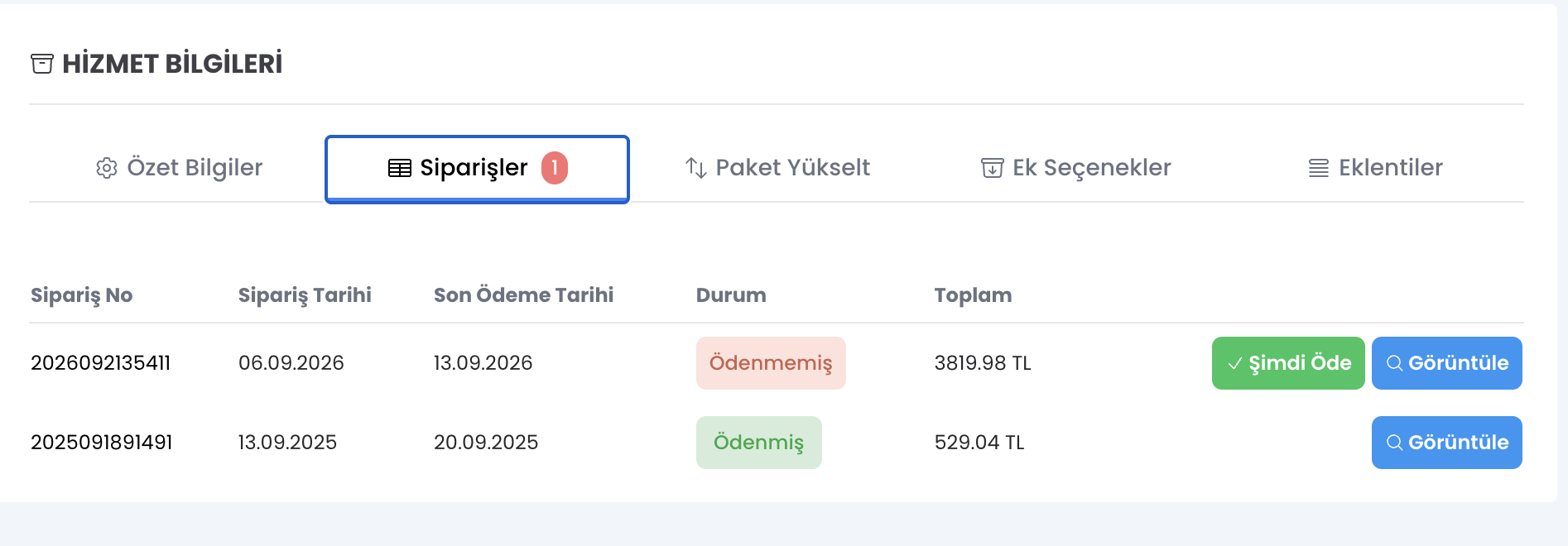
529 TL in September 2025. The September 2026 renewal: 3,820 TL.
A 7.2-fold increase in one year. Over the same period annual inflation was 31.5% and the currency moved 18%. In dollars: $12.93 to $78.86.
I do not think you can call that “the promotion ended”. If there is a seven-fold gap between the promotional price and the renewal price, there is no discount, there are two separate price lists. A promotion for the new customer, the list price for the one who has been there eight years.
To put it plainly, what is being priced here is not the service. It is the assumption that the customer will not move.
For scale: shared hosting in Turkey currently runs somewhere between 500 and 2,500 TL a year. The same provider advertises shared hosting on its own site from under a dollar a month. This customer was paying $176 a year for something in the same category.
So what changed
What we had failed to convey for years was conveyed not by a spreadsheet but by an incident.
An old Joomla installation nobody had touched in a long time was compromised through JavaScript.
What followed took two days. We moved every hosting account onto a reseller plan, took the nameserver control we had wanted from the beginning, and put everything behind Cloudflare.
A little late, but from our side it worked out. The eight-year bill is still sitting there though, and it was already large before you count what the security incident cost.
What was Ali Rıza Bey’s mistake
It was not malice and it was not incompetence. He simply chose today’s peace over tomorrow’s cost, every single time, and never once put a number on what that choice was worth. That is all it was.
The same thing happens in our line of work. We just call it “let’s not touch a system that works”.
Four things I took away:
Postponement is not a decision, but its invoice weighs as much as one. And that invoice arrives every year, quietly, on a standing payment order. I was circling the same idea when I wrote There Is No Such Thing as “We Will Delete It Later”.
Not every price rise is a bad one. The increases between 2020 and 2023 were entirely justified. If you cannot defend the justified ones, you cannot make a convincing case about the unjustified ones either.
Do not track supplier invoices in a single currency. Under high inflation, the local currency hides everything. Looked at through two measures, it cannot. This is half an hour in a spreadsheet, by the way. It requires no expertise.
A system that does not change is not a safe system. It is merely an untouched one. Most of the time it takes a security incident to teach you the difference, and that is exactly what happened to us.
Note: The amounts come from the customer’s own invoice records. Billing was six-monthly between 2017 and 2019, so I used annual totals; the dollar figures for those three years are not directly comparable with the later ones. Exchange rates are approximate monthly averages for USD/TRY. Inflation figures are TurkStat year-end CPI rates. I ignored VAT, since the gap is measured in multiples and VAT does not change the conclusion. I am not naming the provider, because this is not really about one company.